NFT Marketplace for Real Estate
NFT Real Estate Marketplace: Virtually integrating real-world aspects into a decentralized medium through NFTs.
NFT Real Estate Marketplace: Virtually integrating real-world aspects into a decentralized medium through NFTs.
Years of
Continuous Innovation
AI and Blockchain
Projects Delivered
Cryptocurrencies
Listed on CMC & CG
Play-to-Earn
Platforms Developed






Imagine if we could buy a piece of land in the form of NFT and borrow against that NFT from DeFi at very low interest. Why would anyone willingly go to loan sharks for mind-numbingly long paperwork?
NFTs are now the most trusted way to own an asset in this digitized world, and the trend for NFTs is continuously growing and evolving into the next big thing. As we know, NFTs are smart contracts on decentralized nodes that enable specific individuals to take ownership of their assets, which they can trade, sell, or loan in the futuristic market for significant profit. The scarcer or more unique an asset, the higher its value.
NFTs are permeating every aspect of society; there's a growing trend to integrate NFTs with the real estate market. As technology pushes the boundaries of conventional thought, virtualization is becoming a parallel world, populated by inconceivable human imagination.
Before the technological boom, people would buy a property and get entangled in lengthy and tedious paperwork. Before they even considered moving in, another selling opportunity might arise, leaving them stuck in paperwork again. As the saying goes, "Time is Money," and they would lose potential gains. Similar to "Billionaires Row" in New York City, where apartments worth $20M to $30M remain unoccupied, people today acknowledge the need for technological change in the real estate sector.
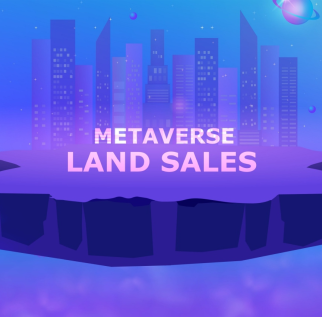
With the concept of the metaverse gaining traction through various means, sales of land plots on existing metaverse-based platforms have been exploding in the era of NFTs. This is evidenced by someone paying a hefty $4.3 million for a plot of land on the metaverse real estate-based game Decentraland, and another paying $50,000 to own property next to Snoop Dogg's in The Sandbox. Hence, it is certain that metaverse real estate plots will be hot assets to hold in the future, especially if the next step from tech giant Meta (formerly Facebook.Inc) towards realizing the metaverse happens sooner. It is also possible that copies of real-world plots will be created on a metaverse, where virtual plots would back real-world plots, and transactions can be recorded on smart contracts, thereby eliminating lengthy paperwork.
Decentralization is at the core of the blockchain world, and it also encompasses NFT real estate. A decentralized NFT real estate marketplace would enable peer-to-peer (P2P) trading of real estate without the involvement of third parties. Lengthy and slow paperwork would also be eliminated since the process already involves smart contracts. Such an NFT real estate marketplace saves time and money for both buyers and sellers, making real estate a more accessible investment option.
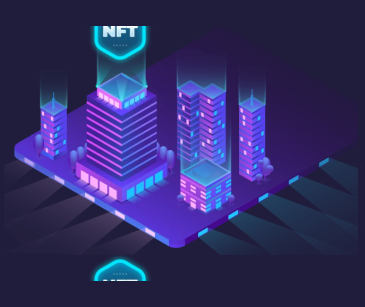
This cutting-edge blockchain technology is a major component and a key driver of virtualization. People are now converting their property assets into NFTs due to their interoperability, transparency, and consensus mechanisms. Land NFTs are not only becoming a physical world service but are also integrating virtually. Several services running on the blockchain platform provide a virtualized aspect of real-life experiences. For example, "Decentraland" is a virtual platform where one can buy virtual plots as NFTs and use them as virtual offices, shops, schools, universities, or even malls for promotional events of new products—anything that happens in the real world can be replicated here. Imagine the possibility of a world free from pandemics or having a virtual school for the farthest corners of the world, reliving moments, or having a cup of tea with the greatest minds.
There is full transparency in transferring property ownership completely, not in fractions.
In real estate NFTs, you don't need to physically move or interact with the property, unlike in art or music. All processes revolve around paperwork.
Rising marginal costs, realtor fees, and other fractional costs are the primary hurdles in real estate that deter potential customers. By using NFTs, all overhead costs are eliminated, resulting in a fair price.
NFTs do not eliminate all paperwork for property transactions, such as tax forms and deed forms, but they do streamline the process by skipping several steps.

The inherent immovability of real estate makes it an ideal asset to be used as collateral on blockchain platforms, allowing secure and verifiable third-party access.

Smart contracts enable automated execution of real estate sales, loans, and lease agreements, ensuring transparency and reducing the need for intermediaries.

Virtual land ownership transforms digital assets into valuable investments, providing verifiable proof of ownership and the ability to trade them securely on blockchain platforms.

Blockchain validation eliminates the risk of fraudulent property claims by ensuring every piece of land or asset has an authentic and traceable ownership record.
Our teams at Techfyte will provide you with cutting-edge technology. With research centers around the world, your project will benefit from the utmost user experience.

Our team helps you tokenize collectibles, develop intuitive user interfaces, create mobile dashboards, and implement all necessary marketplace features seamlessly.

Techfyte provides a pre-built, customizable white-label NFT marketplace blueprint, ready for rapid deployment to match your specific branding and functional needs.

Our research and marketing experts provide strategic insights into the global token landscape, guiding you through the creation of innovative and high-performing NFT tokens.

Techfyte develops secure and efficient NFT minting platforms using robust smart contracts that ensure transparency, scalability, and multi-chain interoperability.
An NFT real estate marketplace is a platform where plots of land, either real-world or metaverse-based, can be traded. The marketplace can be centralized or decentralized, which affects how trading is carried out.
Investing in NFT real estate is straightforward — you simply purchase an NFT representing the plot of land you want from a marketplace, with minimal paperwork involved.
NFTs in real estate can act as proof of ownership for a real-world land parcel or function as land in a metaverse. They can also be used as collateral or as a primary ownership document.
Creating real estate NFTs is simple — you import the land plot’s details into a smart contract, which then mints the NFT and enables automated transactions.